 English
 Swedish
 Danish
 Norwegian
 Finnish







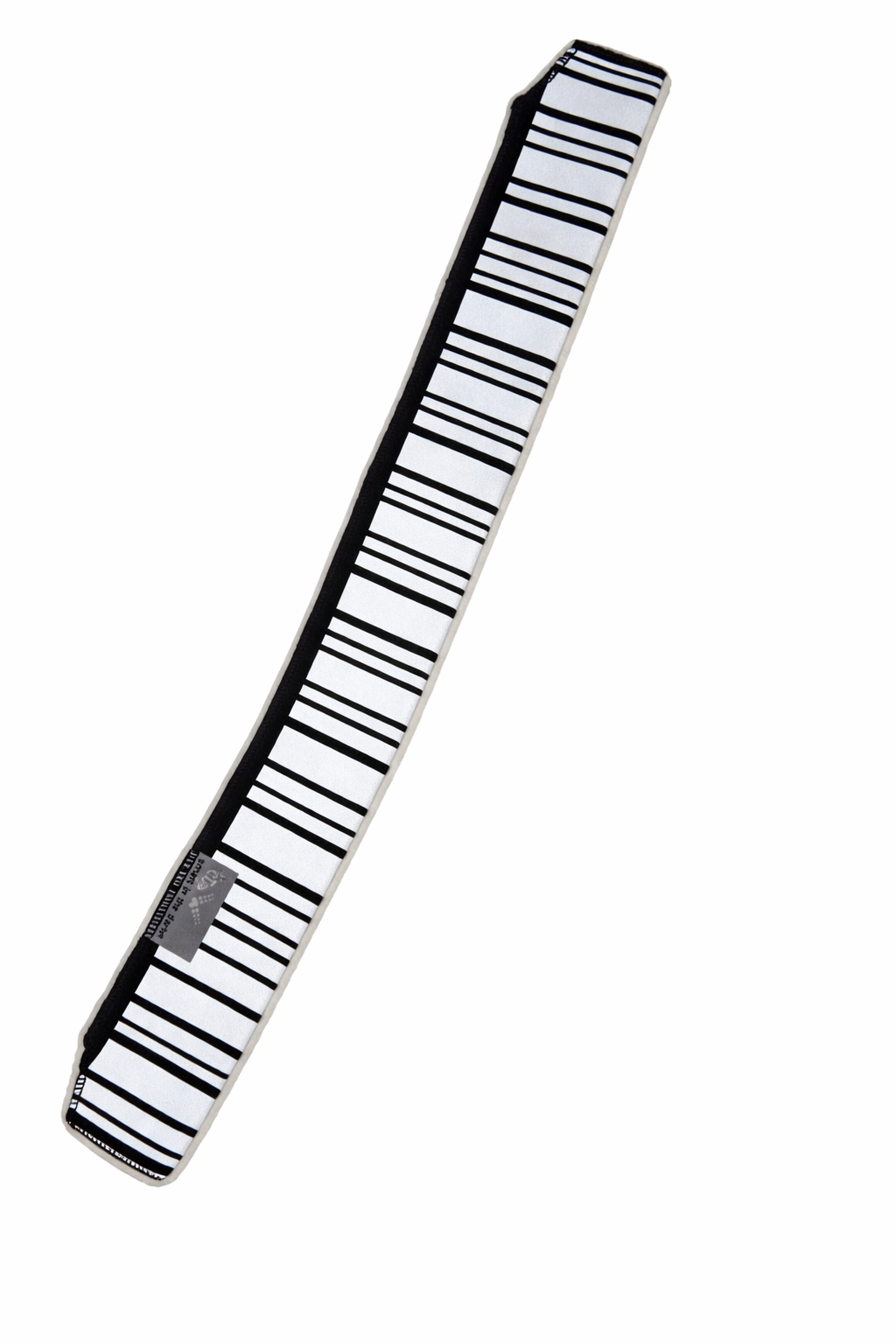










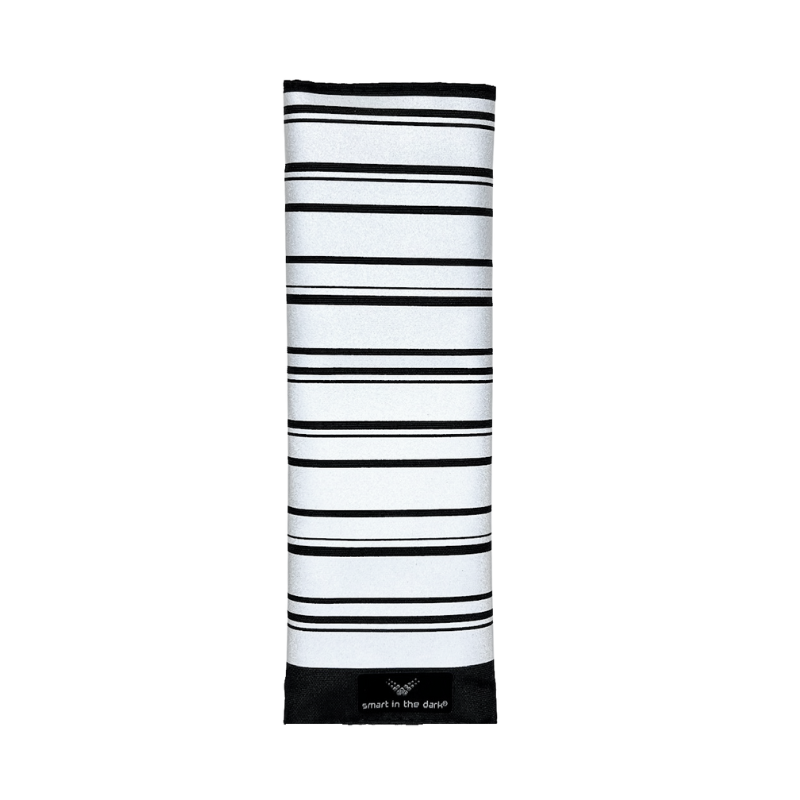







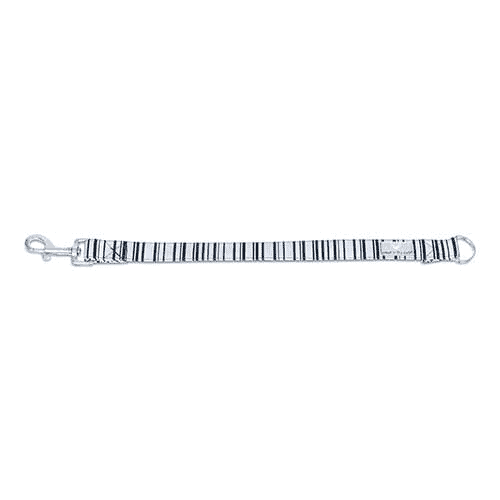
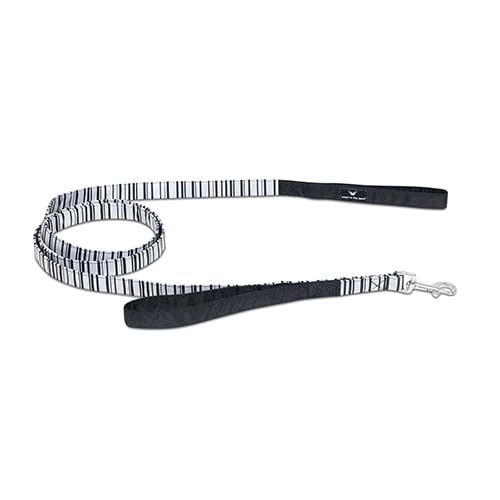
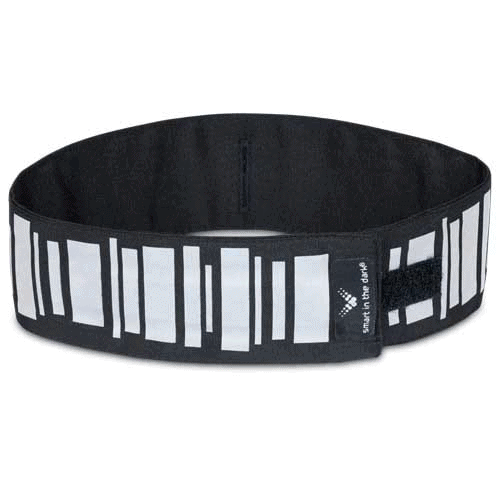

Walking Safety & Guides, Reflector Safety, Tips & Guides
Pedestrian Safety Reflectors: Why They Matter When Walking at Night
You know the feeling. It’s getting dark earlier than you expected, you’re heading home after work or walking the dog round the block, and somewhere in the back of your mind you wonder: can drivers actually see me right now?
The honest answer, according to research, is probably not as well as you’d hope. Most of us tend to overestimate how visible we are in the dark and underestimate just how much of a difference pedestrian safety reflectors can make. Not just a little, but dramatically.
The good news is that staying visible doesn’t require a fluorescent vest or a bulky clip-on. With the right reflective wear for walking, it’s something that fits seamlessly into how you already dress and move.
|
125m |
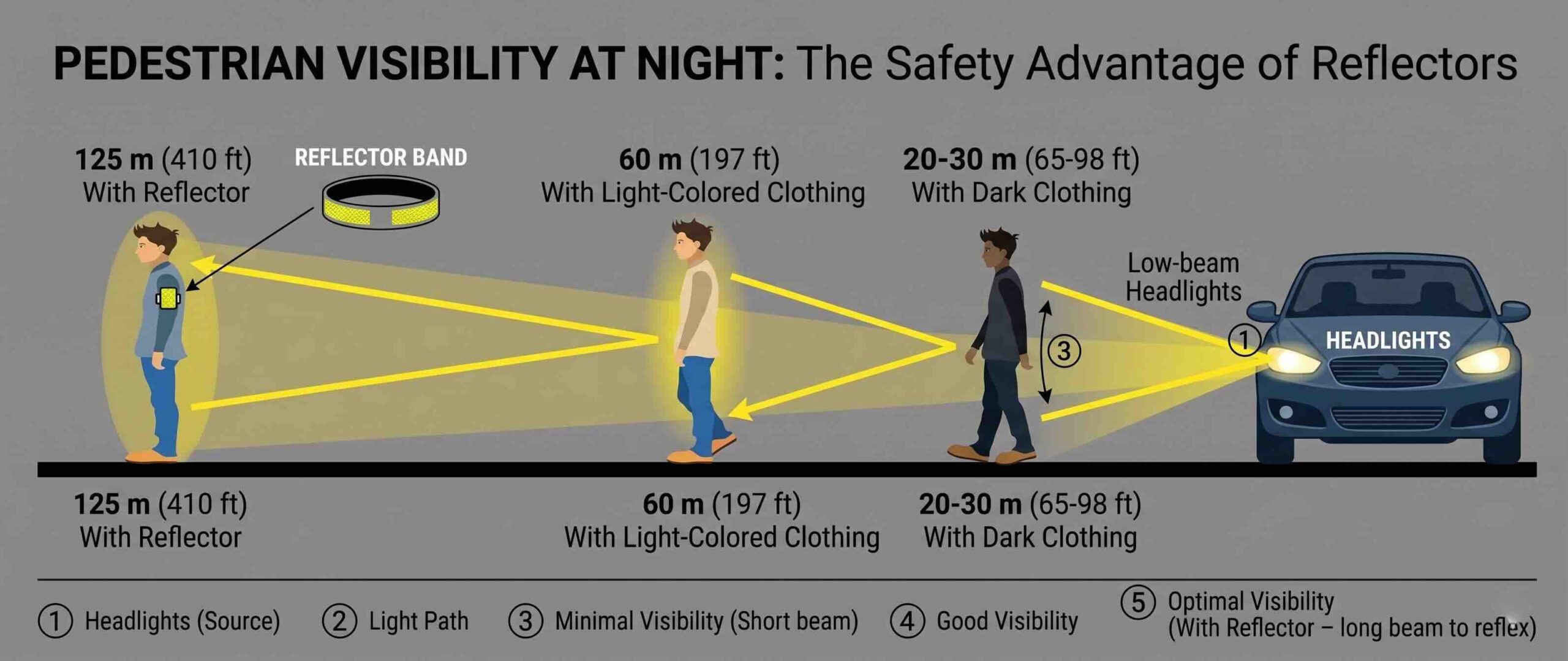
How far away a driver can spot someone wearing a reflector – compared to just 25 metres (80 feet) in dark clothing, or 50–60 metres (165–195 feet) in white clothing. [1] |
|
74% |
Of all pedestrian traffic deaths in the US occur in dark conditions (NHTSA, 2024). Across the UK, Ireland, Canada and Australia, the pattern is consistent: darkness is by far the most dangerous time to walk. [2, 3] |
|
5× |
A pedestrian hurt in a night-time collision is five times more likely to be killed than one injured in daylight. [4] |
Nighttime Walking Safety: What the Dark Actually Does to Your Visibility
Most of us walk in the dark far more than we realise. The commute home, the school run, taking the dog out after dinner, popping to a shop on a winter evening. These are ordinary, everyday moments – and in autumn and winter, for many of us they happen largely in darkness.
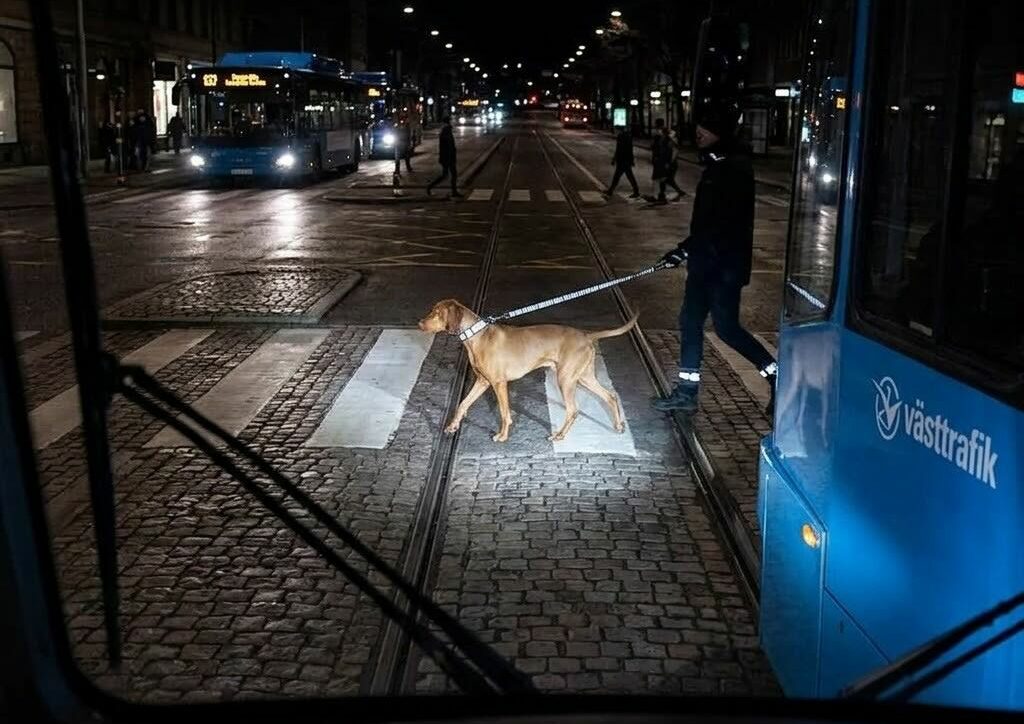
Here’s something that surprises most people when they first hear it: a pedestrian in dark clothing against a dark background gives a driver almost no visual contrast at all. Your brain might feel like you’re visible under a street lamp, but to a driver’s eyes, adjusting between oncoming headlights, reflections on wet tarmac and their own dashboard, you can effectively disappear.
Transport researchers call this a problem of conspicuity: not whether there is light, but whether you stand out within it. And the data from road safety authorities in every country where this has been studied shows the same thing: collisions involving pedestrians are significantly more likely after dark, even accounting for the fact that there are fewer people on the roads at night.
“The issue isn’t that it’s dark. It’s that nothing tells a driver’s eyes where to look.”
Road safety data consistently records a sharp rise in pedestrian incidents in late autumn and winter across the Northern Hemisphere – and in the winter months of June to August in Australia. The routes don’t change. The habits don’t change. But the light does.
How Safety Reflectors for Walking Actually Work – and Why the Science Is Reassuring
The solution is not complicated, not expensive, and not something you have to think about twice once it’s part of how you dress.
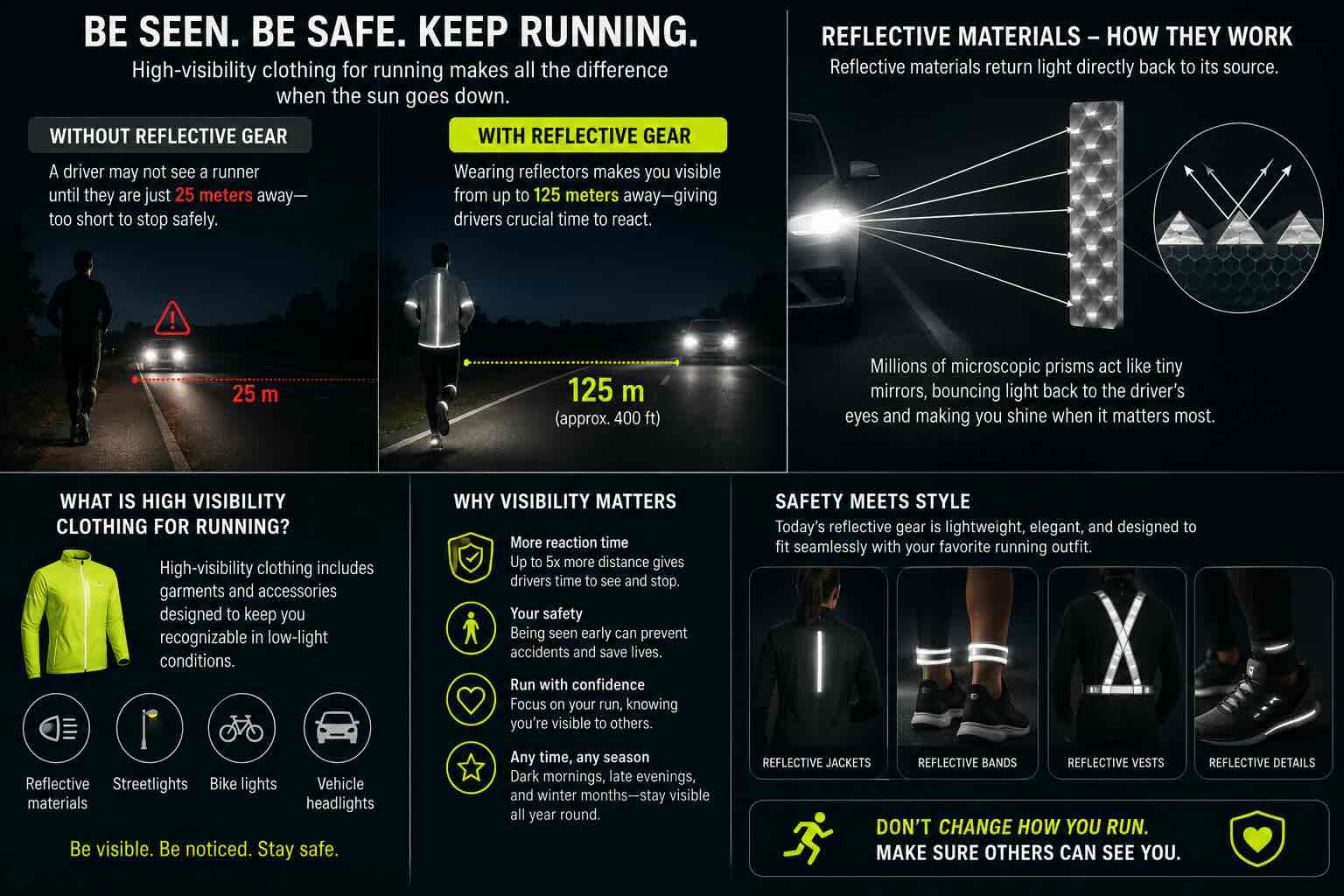
Retroreflective material – the kind used in quality safety reflectors for walking – doesn’t just scatter light. It sends it back directly towards the source. Which means that when a driver’s headlights hit a reflective surface on your body, that light returns straight to the driver’s eyes. Even a small reflective detail, on a hat or a bag, can make you visible at a distance that gives a driver time to slow down, move over, and see you clearly.
The distance that changes everything
Research shows that pedestrians wearing a reflector are visible to drivers from at least 125 metres (410 feet) away. Someone in dark clothing, by contrast, may not be seen until they are just 20–25 metres (65–80 feet) away – and even white clothing only extends that to around 50–60 metres (165–195 feet). [1]
At a typical residential speed of 50 km/h (31 mph), a driver needs around 35 metres (115 feet) to stop in an emergency. At 25 metres (80 feet), there is almost no time. At 125 metres (410 feet), there is plenty. A pedestrian safety reflector doesn’t just make you visible – it gives everyone enough time to make safe decisions.
Why movement matters more than size
Where you wear reflective material matters as much as how much you wear. Research found that reflectors placed on moving joints – wrists, elbows, knees, ankles – are significantly more effective than a reflective panel on the torso alone. [5]
Our brains are wired to recognise human movement. When reflective details move rhythmically – a wrist swinging, a hat bobbing slightly – the visual system registers it as a person almost instantly. It’s why a reflective hat or arm band you’re already wearing works so naturally: the motion is built in.
“I Think I’m Visible Enough” – and Why Most of Us Are Wrong
This is probably the most quietly important finding in the research: pedestrians consistently overestimate how well they can be seen in the dark – and consistently underestimate how much difference a reflector would make. [6]
It’s not carelessness. It’s just human nature. We experience ourselves as present and visible from the inside. We can see our own hands, feel our own feet on the pavement. The idea that a driver might not register us at all until it’s almost too late doesn’t feel intuitive. But that’s exactly what the data shows.
Knowing this changes how you think about staying visible while walking. It isn’t about following rules. It’s about doing something small that makes a genuine, measurable difference – every single time you step outside after dark.
Choosing Pedestrian Safety Reflectors You’ll Love Wearing
There’s a reason so many people know they should wear a reflector – and still don’t. For a long time, the only options were uninspiring at best: a dangling orange disc, a yellow strap, something you’d clip on and quietly take off before anyone saw you wearing it.
Research on attitudes to reflective clothing found something telling: willingness to wear reflectors has far less to do with safety awareness than with how appealing the design is. [7] A beautiful reflector is not a luxury. It’s the whole point. Design is what makes safety wearable.
A few things worth knowing when choosing safety reflectors for walking:
- Look for certified retroreflective material. 3M Scotchlite and equivalent tested materials ensure real visibility at distance – not just a silvery sheen that looks reflective in a shop.
- Think about movement. Something that moves with you – a reflective hat, a bag charm, an arm band – works harder than something static on your back.
- The best reflector is the one you actually wear. Choose something that fits naturally into your life and wardrobe. You shouldn’t have to think twice about it.
- You don’t have to choose between safe and stylish. That used to be the compromise. It doesn’t need to be anymore.
For a complete overview of options, see our guide to the best reflective gear for walking.
Pedestrian Safety by Country: How the Numbers Look Where You Are
The challenge of pedestrian visibility after dark isn’t unique to any one country – but the statistics, the seasons, and the context vary. Here’s how things look in the places where Smart in the Dark’s products are worn.

🇬🇧 United Kingdom: The Clock Change That Changes Everything
| 409
pedestrian deaths, 2024 |
8/week
on UK roads |
In the UK, 409 pedestrians were killed in 2024 – roughly eight every week (DfT/Brake). A disproportionate number of those collisions occur after dark. |
Every year on the last Sunday of October, the clocks go back and millions of everyday walking journeys that happened in twilight suddenly happen in complete darkness, overnight. School runs. Commutes. The walk to the bus stop. The routes don’t change; the light does.
Transport research based on UK STATS19 data confirms that the likelihood of a pedestrian being hit increases significantly in darkness – even when controlling for lower traffic volumes. [4] Road Safety Week, held each November and run by the charity Brake, consistently highlights pedestrian visibility as a critical issue on UK roads.
🇮🇪 Ireland: A Legal Requirement – and a Sobering Autumn
|
44 pedestrian deaths, 2023 |
~50%
of road deaths 8pm–8am |
In 2023, 44 pedestrians were killed on Irish roads – the highest number since 2011 (RSA). Almost half of all fatalities occurred between 8pm and 8am, despite lower traffic volumes. |
Ireland is one of the few countries where child pedestrian reflectors are written into law: children under 12 are required to wear reflective clothing when walking on public roads after dark. It’s a rule that acknowledges, in the clearest possible way, that visibility saves lives.
The RSA’s own data shows that between October and December, as the dark evenings set in, pedestrian serious injuries rise sharply, with over half of Q4 injuries occurring in darkness. [3] The pattern is almost clockwork, which makes autumn the single most important season to have your kit in order.
🇺🇸 United States: A Growing Crisis After Dark
| 74%
of pedestrian deaths after dark |
7,080 pedestrians killed, 2024 |
74% of pedestrian traffic deaths in the US occur in dark conditions (NHTSA, 2024).
Fatal pedestrian crashes at night rose 84% between 2010 and 2023 – compared to 28% in daylight. |
The scale of America’s pedestrian safety challenge is striking. In 2024, 7,080 people were killed while walking on public roads and nearly three-quarters of those deaths occurred after dark (NHTSA). [2] Night-time pedestrian fatalities have nearly doubled since 2010, a rise that far outpaces the overall increase in traffic deaths.
There is no national law in the US requiring pedestrians to wear reflectors – visibility requirements vary by state. But the data is unambiguous: after dark, being seen is the single most important factor in whether a walking journey ends safely. One in four fatal pedestrian crashes is a hit-and-run, making the stakes of invisibility even higher.
🇨🇦 Canada: How to Stay Visible During Canadian Winter Walks
| 298
pedestrians killed, 2023 |
21%
of night deaths wore dark clothing |
An average of 322 pedestrians were killed each year in Canada between 2004 and 2023 (Transport Canada). Statistics Canada found that 21% of pedestrian fatalities occurring at night involved dark clothing. |
Canada’s winters are long, dark, and cold and for pedestrians, that combination is uniquely challenging. With daylight hours shrinking sharply from October onwards, a large proportion of everyday walking – to transit, to school, through neighbourhoods – happens in complete darkness.
Statistics Canada’s analysis of pedestrian fatalities found that one in eleven deaths involved a pedestrian wearing dark clothing at night. [8] That’s a proportion that could be dramatically reduced by something as simple as a reflective hat or arm band, which, in the Canadian winter, you’d be wearing anyway.
🇦🇺 Australia: Night Walking Safety During Australia’s Winter Months
| 174
pedestrian deaths, 2024 |
26% rise infatalities, 2025 |
174 pedestrians were killed on Australian roads in 2024 – the highest figure in over a decade (BITRE). In the first five months of 2025, pedestrian fatalities rose 26% year-on-year (ARSF). |
Australia’s pedestrian safety challenge plays out in a different season: winter here falls between June and August, when evenings draw in and early mornings are darker than the rest of the year. For the millions of Australians who walk regularly – nearly 90% walk for transport or leisure each week – the winter months bring a similar visibility risk to those faced in European autumn. [9]
The Australian Road Safety Foundation has flagged a concerning recent trend: after years of gradual improvement, pedestrian fatalities rose sharply in 2024 and again in 2025. Their guidance to pedestrians is clear: wear visible clothing, especially at night or during poor weather conditions. [9, 10]
🇳🇿 New Zealand: Unlit Roads and the Darkness Risk
|
25 pedestrian deaths, 2023 |
68% of NZ road deaths on rural roads |
In 2023, 25 pedestrians were killed on New Zealand roads (ehinz.ac.nz / Waka Kotahi NZTA). 68% of all road deaths in NZ occur on rural roads – many unlit, without footpaths or separation from traffic. |
New Zealand’s road safety story has a distinctive shape. While 2024 saw the country’s lowest per capita road death rate in over 100 years, the pedestrian challenge remains real – particularly after dark and particularly outside of cities. The majority of New Zealand’s road deaths occur on rural roads, many of which have no street lighting, no footpaths, and no separation between pedestrians and traffic. [11]
Waka Kotahi, New Zealand’s transport agency, notes specifically that darkness-related injuries are more common among adults aged 18 and older – the precise demographic most likely to be walking home from work, heading out for an evening run, or walking a country road during the June-to-August winter months. [12] In that context, being seen from 125 metres (410 feet) rather than 25 metres (80 feet) isn’t a minor improvement. On an unlit rural road at night, it can be the only margin that matters.
Small Thing, Real Difference
Pedestrian safety reflectors won’t change the road network or improve street lighting in your neighbourhood. What they will do is make you visible to the person driving towards you – far earlier, far more reliably, and far more simply than almost anything else you could do.
The barriers have never been lower. The designs have never been better. And for the people you walk home with – children, friends, partners, the dog – it’s one of the simplest ways to look out for them.
Take care of yourself and those who matters to you the most! You all matters.

References
[1] Factors affecting pedestrian conspicuity at night: eye tracking study – ScienceDirect (2021)
[2] NHTSA / Injury Facts: Pedestrians and Car Crashes (2024 data)
[3] RSA Pedestrian Spotlight Report 2020–2024 – Road Safety Authority Ireland
[4] Road Safety Week 2025 – Humberside Fire & Rescue, citing DfT/University of Sheffield data
[6] On-road measures of pedestrians’ estimates of their own nighttime conspicuity – ScienceDirect (2004)
[7] Reflective Clothing is Attractive to Pedestrians – ResearchGate (2004)
[8] Pedestrian Fatalities in Canada 2018–2020 – Statistics Canada
[9] Pedestrians – Australian National Road Safety Data Hub (BITRE)
[10] Why Are Pedestrian Fatalities Rising in Australia? – Australian Road Safety Foundation (2025)
[11] RSA Road Deaths 2023 – Road Safety Authority Ireland
[12] GHSA: Pedestrian Traffic Fatalities by State, 2024 Preliminary Data
[13] Road Traffic Injury Mortality 2023 – Environmental Health Intelligence NZ (ehinz.ac.nz)
[14] NZ Pedestrian Profile – Waka Kotahi NZTA (darkness injuries, rural road context)